








Both tests let you check for sleep apnea in your own bed, in one night. But they measure your breathing in very different ways. Here is how they work, what each one is good at, and how to choose.
Choose ApneaLink Air if…
you want your breathing measured directly at the nose, you have a heart rhythm problem such as atrial fibrillation, a pacemaker, or you take medication that affects your blood vessels. For most people being tested for obstructive sleep apnea, it is our default recommendation.
Choose WatchPAT ONE if…
you would rather avoid a nasal cannula and a chest belt, you want an estimate of your sleep stages, or you prefer a single-use device that never has to be sent back.
Two ways to measure the same night
Sleep apnea means your breathing repeatedly stops or becomes shallow while you sleep. Every home sleep test tries to count those events and turn them into one number: the Apnea-Hypopnea Index, or AHI – the average number of breathing events per hour. The two tests in this guide arrive at that number by different routes.
ApneaLink Air
Measures breathing directly- A thin nasal cannula records airflow and snoring at the nose
- A belt around the chest records breathing effort
- A finger sensor records oxygen saturation and pulse
- Small reusable recorder worn on the chest
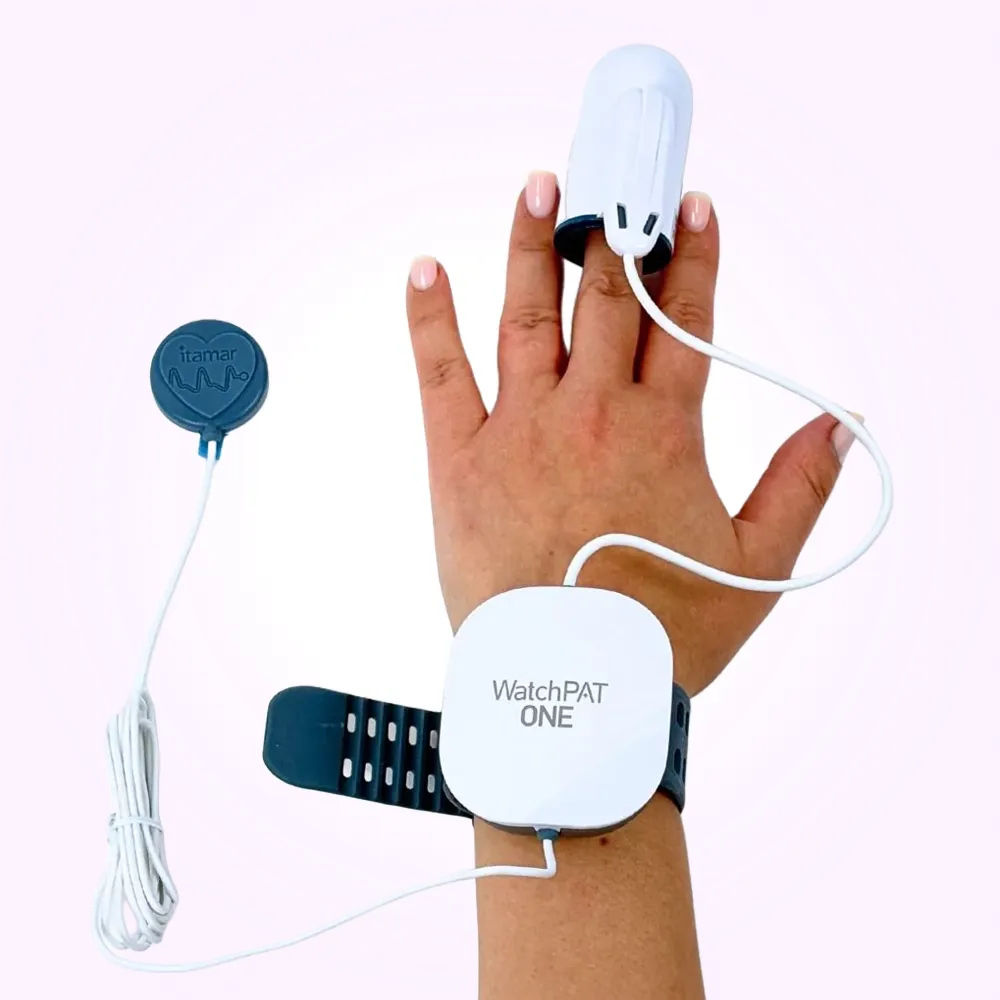
WatchPAT ONE
Measures the body's response- A finger probe reads the PAT® signal – tiny changes in blood flow in the fingertip
- The same probe records oxygen saturation and pulse
- A small chest sensor records snoring and body position
- Single-use wrist device that sends data to your phone
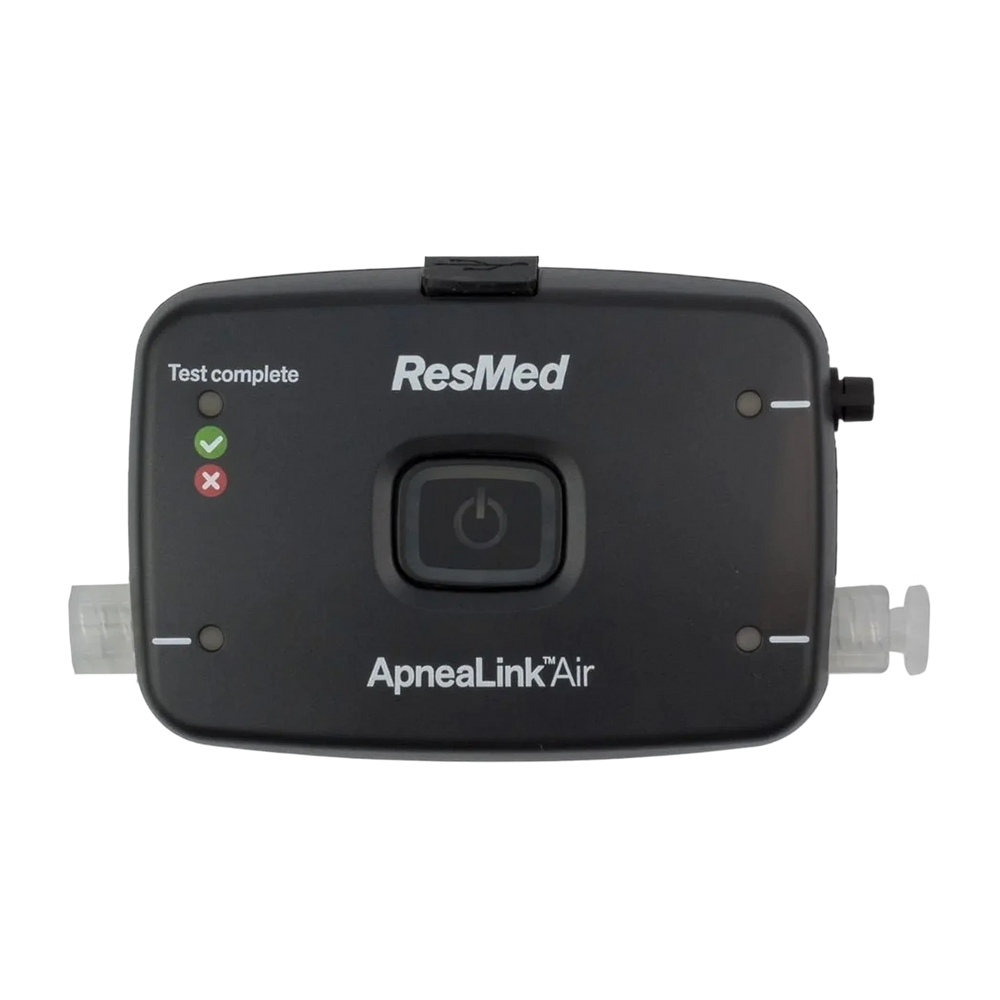

The difference is easiest to understand like this. ApneaLink Air watches the air going in and out of your nose and the movement of your chest – the breathing itself. WatchPAT ONE watches what your body does in reaction to a breathing pause: when breathing stops, your nervous system tightens the small blood vessels in your fingertips, and the PAT® signal picks that up. Together with oxygen levels and pulse, an algorithm then estimates when breathing events happened.
Both approaches are recognised by the American Academy of Sleep Medicine as acceptable technologies for home sleep apnea testing in adults with a high likelihood of moderate to severe obstructive sleep apnea.
Side by side: the key differences
| ApneaLink Air | WatchPAT ONE | |
|---|---|---|
| Test type | Type III home sleep test | PAT-based home sleep test |
| Airflow at the nose | Yes – nasal pressure cannula | No – breathing events estimated indirectly |
| Breathing effort | Yes – chest belt | Chest movement via chest sensor |
| Oxygen saturation and pulse | Yes | Yes |
| Snoring | Yes | Yes |
| Sleep stages | No | Estimated (REM, light, deep, wake) |
| Heart rhythm problems | Can be used | Not suitable with sustained arrhythmia or certain pacemakers |
| Smartphone needed | No | Yes, with Bluetooth and internet |
| After the test | Device is returned | Device is disposed of |
How accurate are they?
Neither test is as complete as an overnight study in a sleep lab (polysomnography), which records brain waves, eye and muscle activity and much more. Home tests are designed to answer one practical question: does this person have obstructive sleep apnea, and roughly how severe is it? For that question, both devices have been compared with lab studies in published research and show good agreement with them.
Each method has its own blind spots, and it helps to know them:
ApneaLink Air's strength
It measures airflow at the nose – the same kind of signal sleep labs use to score apneas and hypopneas – and breathing effort from the chest belt. That makes the breathing events themselves directly visible in the recording.
ApneaLink Air's limitation
It doesn't know when you are asleep. The AHI is calculated over the whole recording time, including time you lie awake, which can make it a little lower than your true value.
WatchPAT ONE's strength
It estimates when you are actually asleep, so the AHI is calculated per hour of sleep rather than per hour in bed. It also shows whether events cluster in REM sleep or in a certain body position.
WatchPAT ONE's limitation
Breathing events are inferred from the PAT® signal, oxygen and pulse rather than measured at the nose. Anything that changes how your blood vessels and heart respond – rhythm disorders, some medications – can affect the result.
In practice: if the result is clearly positive or clearly normal, either test gives you a useful answer. If symptoms and result don't match – for example, you snore loudly and feel exhausted but the test is normal – that is a reason to talk to a sleep specialist, whichever device you used.
The heart rhythm question
This is the point where the two tests differ most for real people, and it deserves its own section.
Sleep apnea and heart rhythm problems often go together. Atrial fibrillation, for example, is noticeably more common in people with untreated sleep apnea. Because WatchPAT ONE relies on signals from your blood vessels and pulse, the manufacturer lists situations where it should not be used:
WatchPAT ONE is not suitable if you have:
- A sustained irregular heart rhythm, such as persistent atrial fibrillation
- A permanent pacemaker with atrial pacing, or VVI pacing without sinus rhythm
- Taken alpha blockers or short-acting nitrates less than 3 hours before the test
ApneaLink Air measures airflow and breathing effort directly, so an irregular pulse or a pacemaker does not stop the test from recording your breathing. If any of the points above apply to you – or you are not sure – ApneaLink Air is the safer choice.
What test night feels like
Comfort matters more than it sounds. A test only works if you sleep reasonably normally while wearing it.
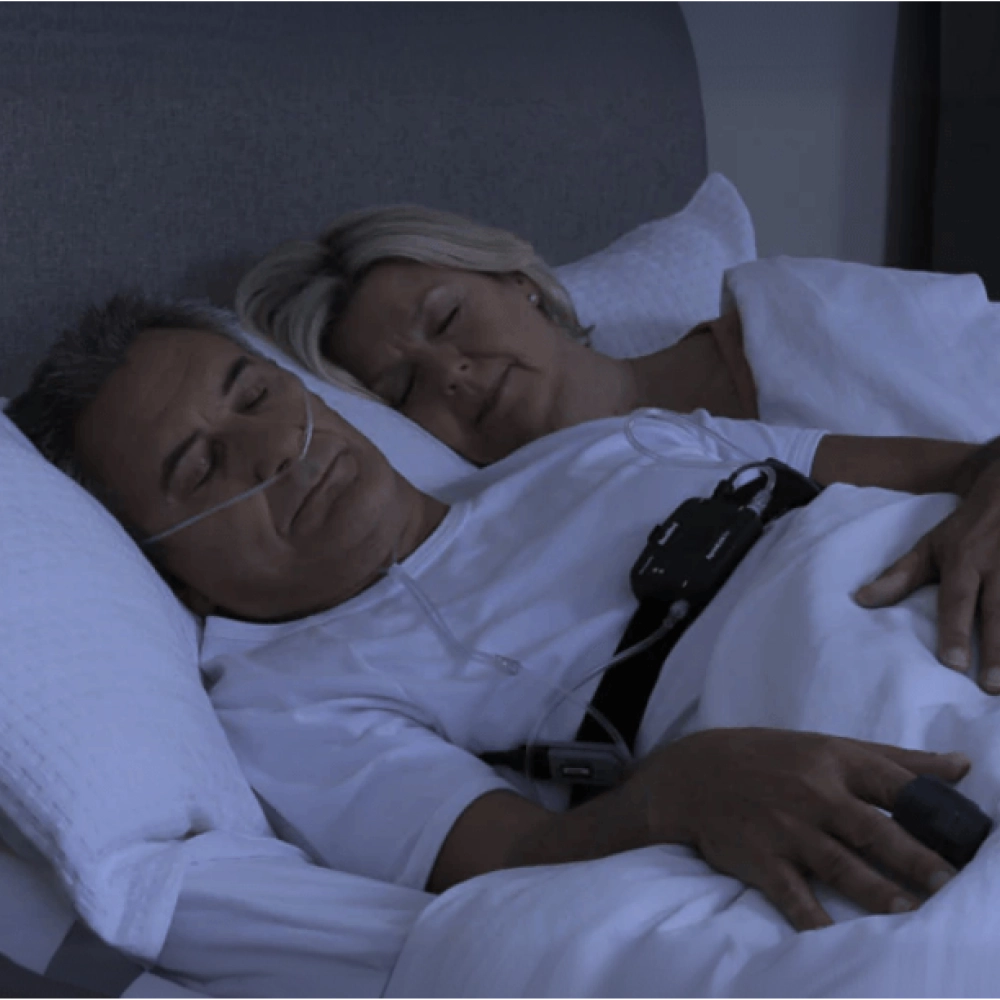
With ApneaLink Air
You fasten the belt around your chest with the small recorder attached, place the thin cannula under your nose and over your ears, and put the sensor on your finger. Most people get used to it within a few minutes. The main thing to watch is that the cannula stays in place – a piece of medical tape on the cheeks helps if you move a lot. In the morning you take everything off and send the device back.
With WatchPAT ONE
You install the app on your phone, strap the device to your wrist, attach the small chest sensor below your neck and slide your finger into the probe. There is nothing in your nose and no belt. Your phone needs to stay charging and close to the bed overnight, because the data is sent through the app. In the morning you end the recording in the app and dispose of the device.
Tip for either test: go to bed at your usual time, avoid alcohol that evening and sleep in the position you normally sleep in. The goal is to record an ordinary night, not your best one.
Which test fits your situation
You have atrial fibrillation, another heart rhythm problem or a pacemaker
ApneaLink Air
You take alpha blockers or short-acting nitrates
ApneaLink Air
You want the breathing events measured directly, the way a sleep lab does
ApneaLink Air
You don't have a smartphone, or prefer not to use one for the test
ApneaLink Air
You can't tolerate anything in or near your nose
WatchPAT ONE
You'd like to know whether your apnea is worse in REM sleep or on your back
WatchPAT ONE
If none of these stand out, either test will do the job. For most of our customers, we recommend ApneaLink Air: it measures breathing directly, it can be used with heart rhythm conditions that are common in people with sleep apnea, and it doesn't depend on a phone working through the night.
How the ApneaLink Air test works with us
At CPAPeuropa, the ApneaLink Air home sleep test takes three steps:

Book online
Order the test on our Home Sleep Test page and the device is delivered to your door.
Sleep one night at home
Put on the device at bedtime and sleep as usual. It records your breathing, oxygen levels and heart rate while you sleep.
Receive your results
Your recording is reviewed manually and analysed with ApneaLink software. Your report shows whether sleep apnea was detected and your Apnea-Hypopnea Index (AHI).
Good to know: the test report is not an official medical diagnosis or prescription. If you need one – for example, to start CPAP therapy – a registered sleep physician can provide it for an additional fee.
When a home test isn't enough
Home sleep tests are designed for adults with a high likelihood of obstructive sleep apnea. A full sleep study in a lab is usually the better route if you have significant heart or lung disease, a neuromuscular condition, suspected central sleep apnea, or symptoms that suggest another sleep disorder – such as narcolepsy, acting out your dreams or restless legs. A negative home test in someone with strong symptoms should also be followed up with a sleep specialist.
Frequently asked questions
Is WatchPAT ONE or ApneaLink Air more accurate?
Both show good agreement with lab sleep studies in published research. ApneaLink Air measures airflow and breathing effort directly; WatchPAT ONE estimates breathing events from the PAT® signal and calculates AHI per hour of sleep. Which one is more suitable depends mainly on your health – especially your heart rhythm – and on what you can comfortably sleep with.
Can I use WatchPAT ONE if I have atrial fibrillation?
Not if it is a sustained irregular rhythm, such as persistent atrial fibrillation. The manufacturer also excludes certain types of pacemakers and use within 3 hours of alpha blockers or short-acting nitrates. In these situations, ApneaLink Air is the better choice.
Does ApneaLink Air show my sleep stages?
No. It records airflow, breathing effort, oxygen saturation, pulse and snoring, but it does not estimate sleep stages. WatchPAT ONE estimates REM, light sleep, deep sleep and wake periods.
Is the nasal cannula uncomfortable?
It is the same thin, soft tube used for oxygen therapy and rests just inside the nostrils. Most people get used to it within minutes. If you move a lot in your sleep, a small piece of medical tape on each cheek keeps it in place.
Can either test diagnose central sleep apnea?
Home tests are mainly designed for obstructive sleep apnea. ApneaLink Air's chest belt helps distinguish obstructive events from central ones, and WatchPAT ONE estimates a central apnea index from its chest sensor. If central sleep apnea is suspected, a full sleep study is usually recommended.
What happens if the test shows sleep apnea?
You receive a report that shows whether sleep apnea was detected and your AHI. The report is not an official diagnosis; with our ApneaLink Air test, a registered sleep physician can provide a diagnosis and prescription for an additional fee. For most people with moderate or severe obstructive sleep apnea, the next step is CPAP therapy.
Do I need a prescription for a home sleep test?
No prescription is needed to book our ApneaLink Air home sleep test. Requirements for starting treatment differ between European countries; if you are unsure what applies where you live, contact us and we'll explain the options.
Sources
- Kapur VK, Auckley DH, Chowdhuri S, et al. Clinical practice guideline for diagnostic testing for adult obstructive sleep apnea: an American Academy of Sleep Medicine clinical practice guideline. J Clin Sleep Med. 2017;13(3):479–504.
- Yalamanchali S, Farajian V, Hamilton C, Pott TR, Samuelson CG, Friedman M. Diagnosis of obstructive sleep apnea by peripheral arterial tonometry: meta-analysis. JAMA Otolaryngol Head Neck Surg. 2013;139(12):1343–1350.
- Itamar Medical. WatchPAT ONE instructions for use – contraindications.
- ResMed. ApneaLink Air product information.
Please note: this article is for general information and isn't medical advice. Which sleep test is suitable for you should be confirmed with your doctor or sleep specialist, particularly if you have a heart condition, lung disease or take regular medication.